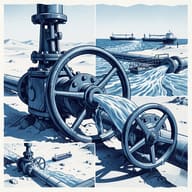
0914 | AI Jitters, Oil Shock and a 5% Yield: Markets Under Pressure
Show notes
A fast tour of a tense market day: AI leaders call for a slowdown and tech sells off, oil spikes after Saudi pipeline attacks, bond yields top 5% ahead of a likely Fed hike, plus crypto legislation, IPOs and corporate headlines.
Timeline
- 00:00:04 Opening
- 00:00:44 AI Slowdown Calls Trigger a Tech Rout
- 00:03:18 Market Reaction: Volatility, Defensives and the VIX
- 00:05:05 Oil Shock: Saudi Pipeline Shut Amid US-Iran War
- 00:06:31 Tanker Windfall and Shipping Trades
- 00:07:47 Fed in Focus: 5% Yields and an Expected Rate Hike
- 00:09:14 Crypto Politics: The Clarity Act Fight
- 00:10:14 Tariffs, Diesel Records and Energy Policy
- 00:11:46 Deals and IPOs: Insurance, Space and M&A Financing
- 00:13:48 Corporate Watch: Banks, Novo and Big Mergers
- 00:14:24 People and Oddities
- 00:15:10 Closing
Related links
- Which matters more to stocks: the bond market or AI risks? The volatility gauge might offer an answer
- US 10-Year Breaches 5% as Inflation, Supply Worries Mount
- Oil Surges as Saudi Arabia Shuts Down Major Crude Pipeline
- AI stocks sink while cybersecurity shares rally on slowdown fears
- AI Scare Threatens Fund Flows Beating Rest of Market 13-to-1
- OpenAI boss Sam Altman spells out how and why the AI industry wants to slow down: 'We could lose control'
- Microsoft sets limits for future AI models as industry throttles frontier development
- This Is A Different Kind of AI Selloff
- China says AI CEOs' call for a slowdown is 'fear mongering'
- Trump phones Nvidia’s Huang at All-In Summit, calls data center opposition a ‘hoax’
- Trump goes scorched earth on AI warnings, raging about data center opposition and regulation
- What Amodei's AI slowdown could mean for Anthropic's imminent IPO
- Stocks Fall as AI Slowdown Fears, Oil Jitters Hit Sentiment
- Not all tech is under fire in Monday's selling, while investors seek refuge in defensive stocks
- Jim Cramer on why 'sitting on your hands' is worth it in this oversold market
- Bank of America expects third-quarter investment banking fees to fall more than 10%; shares slide
- Moynihan Says Bank Is Still Strong, Even If Trading Revenue Comes In Flat
- Satellite images show extent of damage to Saudi Arabia’s oil pipeline that bypasses Strait of Hormuz
- Oil prices rise after Saudi Arabia shuts down critical pipeline that bypasses Strait of Hormuz
- Prediction market traders think gas prices will hit new highs for the year
- Iran says it destroyed U.S. advanced drone over Hormuz as Middle East conflict intensifies
- US Energy Secretary Wright on Mideast Oil Flows, Hormuz, Refining
- Oil Tankers Earn $1 Million a Day as War Leaves Ship Shortage
- Up 3,600%, this freight fund has posted the biggest gains of all on Iran war oil shock
- 'BWET' ETF Doing Too Well, Scaring Investors: Geraci
- Leveraged ETFs, TLT Flows, Boomer Cavities | ETF IQ 9/14/2026
- Worried About 'Overconfidence' In Markets: Huszczo
- 10-year Treasury yield hits 5% for first time since 2023 as traders brace for Fed decision this week
- Counting the votes: Warsh faces a tough battle as the Fed girds for expected interest rate hike
- The Fed is likely to raise interest rates as inflation persists. What that means for consumers
- Junk Firms Plot $13 Billion Debt Refinancings as Rate Hikes Loom
- Trump agrees to ethics requirements in crypto Clarity Act as GOP seeks Democratic votes
- Warren to rip Clarity Act on Senate floor ahead of key preliminary vote
- Why the election could make Washington's looming next fiscal crisis harder
- Trump urges Ukraine to stop ‘knocking out’ Russian oil refineries as U.S. diesel hits record
- Ukraine says it's open to halting attacks on Russian energy after Trump's claims of deal
- Trump administration repeals Biden era greenhouse gas requirements for power plants
- Tariffs Forced Nissan to Speed U.S. Production, Says Americas Chairman
- NFL and midterm elections set up prediction markets for a critical fall season
- Novo CEO tells CNBC why drugmaker is rebranding, needs to 'rethink' obesity strategy
- NextEra, Dominion Offer Virginia Aid to Smooth $67 Billion Deal
- Puig Agrees to Take Control of Isdin in €1.2 Billion Deal
- Aon Draws $65 Billion of Demand for Bond to Fund USI Acquisition
- Bamboo Insurance Backers Seek $700 Million in US IPO
- Canadian Insurer Sagen Plans to Raise Around C$300 Million
- Space startups raise big money in funding blitz as Europe aims to challenge U.S. dominance
- Crispin Odey Loses Bid to Overturn UK Financial Services Ban
- Bond Veteran Bassman Escalates Clash With $14 Billion ETF Issuer
- Crane Collapses on Cars in Miami Financial Center; Four Injured
- Car ownership costs an average of $5,851 a year on top of auto loan payments, analysis finds
- Etihad Airways CEO on Airline, Fuel Prices, IPO
This episode is produced by Bri. Bri uses advanced AI technology to turn the feeds you care about into podcasts made for listening. Contact us at hi@bri.so.
Transcript
Mia: Welcome to the after-market briefing. I'm Mia.
Milo: And I'm Milo. It's the last stretch of a session that gave investors a lot to chew on — AI slowdown warnings hitting tech, an oil shock out of the Middle East, Treasury yields doing something they haven't done since 2023, and a Fed decision staring us down this week.
Mia: The thread connecting all of it is risk repricing. Investors spent months crowding into AI and largely ignoring everything else, and today the market reminded everyone what diversification is for. Let's start with what actually triggered the selling.
Milo: Right — the catalyst was language from the leaders of the biggest AI firms. Anthropic's CEO, Dario Amodei, said the industry must slow the pace at which it improves the capabilities of AI models, amid growing concerns over risks from AI.
Mia: And he wasn't alone. Sam Altman of OpenAI spelled out how and why the industry wants to slow down, warning that "we could lose control" and detailing how AI safety frameworks and a slowdown could actually work. So you've got the industry itself uniting behind the idea of throttling development.
Milo: Microsoft also set limits for future AI models as the industry throttles frontier development — the company wants to be seen as a responsible AI entity as it ramps up model development alongside partners Anthropic and OpenAI.
Mia: The stock reaction was immediate and, interestingly, not uniform. AI stocks sank, but cybersecurity shares rallied on the slowdown fears. Some commentators are calling this a different kind of AI selloff — the argument is that the discourse around risks is starting to merge and mutate, so it's not the usual tech jitters.
Milo: And there's a geopolitical twist. Chinese state media reported that Beijing called the AI CEOs' call for a slowdown "fear mongering," noting that all groups should work together for AI openness and inclusivity.
Mia: Meanwhile, President Trump has been going in the opposite direction entirely — sounding off on social media against Anthropic's Amodei and his suggestion that the industry slow its pace, calling data center opposition a "hoax" during a call with Nvidia's Jensen Huang at the All-In Summit. The administration has encouraged AI's rapid growth and data center development as it seeks an edge over China.
Milo: So you have industry leaders, Washington, and Beijing all pulling in different directions. That's the uncertainty here. And for investors, the open question is whether money diversifies away from these crowded AI funds — which, per Bloomberg, have beaten the rest of the market thirteen-to-one in fund flows. Monday's rout was described as a reminder of the case for diversification.
Mia: Anthropic itself is a company to watch here — Amodei is pushing for this slowdown while the company meets with prospective investors ahead of a potentially historic IPO. That's a tension worth tracking.
Milo: Okay, so from the catalyst to the tape. How did markets actually trade?
Mia: Volatility led the way. The Cboe VIX jumped to 18 on Monday. Futures fell as leaders of the biggest AI firms proposed slowing development, and as oil prices rose after Saudi Arabia closed a major crude pipeline. So two catalysts hitting sentiment at once — and the volatility gauge may actually help answer which matters more to stocks right now, the bond market or the AI risks.
Milo: And notably, not all tech was under fire in Monday's selling — investors were seeking refuge in defensive stocks. That's a classic risk-off signature.
Mia: On the Investing Club side, Jim Cramer's take was that "sitting on your hands" is worth it in this oversold market — which is an observation, not a recommendation, but it captures the mood: the market is stretched, and panicking into a selloff hasn't historically paid.
Milo: One more earnings-adjacent data point on the AI theme: Bank of America expects third-quarter investment banking fees to fall more than ten percent, and shares slid on that outlook. The muted outlook from the country's second-largest bank by assets could be an early signal that Wall Street's AI boom might have hit turbulence.
Mia: Though CEO Brian Moynihan pushed back on the gloom. He said trading revenue will be "relatively flat" compared with last year's third quarter, but even if that happens, the bank will still have had one of its best third quarters ever. So the fee warning and the CEO's confidence are sitting side by side — that's your uncertainty.
Milo: Now let's pivot to the oil story, because it's the second leg of today's risk-off move. Saudi Arabia shut down a major crude pipeline — the roughly 750-mile East-West pipeline that's been used to bypass the Strait of Hormuz during the US-Iran war.
Mia: And the details matter. Satellite images show the extent of the damage. Saudi Arabia says the pipeline came under attack and was closed as a precaution, amid escalating attacks from Iran-allied militant groups in recent days. Bloomberg Intelligence senior energy analyst Rob Barnett called it "effectively a three-alarm fire" in the oil space.
Milo: And the market transmission is already visible. Oil prices have marched higher in recent weeks, above $100 per barrel, as tensions between the US and Iran have escalated again. Today's pipeline closure added to that.
Mia: Iran is also escalating directly — it says it destroyed an advanced US drone over the Strait of Hormuz, as Tehran and Washington trade warnings and strikes with no sign of de-escalation.
Milo: On the policy side, US Energy Secretary Chris Wright says he expects Saudi Arabia's East-West pipeline to the Red Sea to be up and running "very soon." That's the key thing to watch — whether that restart actually happens, and how quickly.
Mia: The knock-on effects are where this gets really interesting for traders. The cost of hiring an oil tanker on the industry's benchmark trade route topped $1 million a day for the first time, because the war has left too few ships willing to cross the Strait of Hormuz to collect cargoes.
Milo: And the shipping trade has been explosive. One freight fund is up 3,600 percent — the biggest gains of all on this Iran war oil shock. Crude oil tanker futures have boomed like nothing else as oil surged and tariffs added to freight stress.
Mia: Even in the ETF world, the Breakwave Tanker Shipping ETF — ticker BWET — is doing what Nate Geraci, president of NovaDius Wealth Management, described as too well — so well it's actually scaring investors. He discussed that on Bloomberg's ETF IQ, alongside ETF M&A and Treasuries, with Sam Huszczo of SGH Wealth Management and others.
Milo: Huszczo's separate concern on that show was overconfidence — how investors might be getting a bit overconfident amid this bull market. That's a fitting note given the day we just had.
Mia: From the tanker market, the natural next stop is rates and the Fed, because energy inflation feeds directly into that story. The 10-year Treasury yield briefly breached 5 percent on Monday — the first time since 2023 — as mounting inflation angst collided with swelling government and corporate borrowing needs.
Milo: It then moved lower after reaching that multiyear high, ahead of this week's Federal Reserve interest rate decision. So the 5 percent print matters, but so does the retreat.
Mia: On the Fed itself: traders were pricing in a better than 92 percent probability of a rate increase, and a more than 75 percent chance for another one in December. The market is widely expecting a quarter-point hike at the September meeting as inflation persists.
Milo: For consumers, that means bracing for higher borrowing costs. And politically, Fed governor nominee Warsh faces a tough confirmation battle as the Fed girds for the expected hike — that's an added layer of uncertainty around the institution itself.
Mia: There's also credit market activity around the rate outlook. Junk-rated borrowers across the globe are lining up at least $13 billion in refinancing deals, trying to lock in tighter credit spreads ahead of potential central bank rate hikes. So the market is positioning ahead of the decision, not just waiting for it.
Milo: Let's turn to Washington on the crypto front, which has its own vote looming. Trump agreed to ethics requirements in the crypto Clarity Act as Republicans seek Democratic votes ahead of a key preliminary vote.
Mia: Senator Elizabeth Warren isn't buying it — she's set to rip the Clarity Act on the Senate floor, calling the ethics proposal blessed by Trump a "weak fig leaf."
Milo: There's a real market angle in the fine print: community banks fear customers will withdraw deposits to buy stablecoin crypto assets that could pay higher yields. That's the deposit-flight risk the industry is watching.
Mia: And behind that vote looms a bigger fiscal fight. Some in the GOP are already disavowing raising the debt ceiling absent deep spending cuts, as the national debt balloons past $40 trillion. The election could make Washington's next fiscal crisis harder — which matters to anyone holding Treasuries at 5 percent.
Milo: Energy policy also connects back to the oil shock. Trump urged Ukraine to stop "knocking out" Russian oil refineries as US diesel hit a record — above $6 a gallon for the first time ever, driven by the Ukraine and Iran wars. And Trump claimed in a social media post that "the World's Diesel price rise is mostly caused by the Russia/Ukraine War, not Iran."
Mia: Ukraine, for its part, says it's open to halting attacks on Russian energy after Trump's claims of a deal. That's a potential de-escalation signal worth watching, though nothing is confirmed.
Milo: On the domestic regulatory side, the Trump administration repealed Biden-era greenhouse gas requirements for power plants — continuing a systematic dismantling of Obama and Biden-era climate regulations. That's a structural shift for utilities and energy producers.
Mia: Tariffs, too, are reshaping corporate behavior. Nissan's Americas chairman, Christian Meunier, said US auto tariffs have been hard to manage, but ultimately pushed Nissan to accelerate localization and production in the United States — though he acknowledged keeping products affordable in North America is a challenge. He made those comments on Bloomberg's Open Interest.
Milo: Prediction markets are picking up on the energy story too — traders there think gas prices will hit new highs for the year. And prediction markets themselves have a big fall ahead, with the NFL season and the midterm elections setting up what traders see as a critical season for the platforms.
Mia: Let's move through the corporate calendar. Novo Nordisk is rebranding and, per its CEO on CNBC, needs to "rethink" its obesity strategy amid stiff competition from Eli Lilly. The Danish drugmaker called the changes the beginning of a new chapter. That's a competitive-positioning story in one of the market's most crowded themes.
Milo: In M&A: NextEra Energy and Dominion Energy unveiled a package of benefits aimed at customers in Virginia, as they pursue regulatory approval for their proposed $67 billion mega-merger. So they're sweetening the deal to smooth the path.
Mia: And in beauty, Puig Brands agreed to buy the 50 percent of Isdin it didn't already own for €1.2 billion — about $1.4 billion — giving it full control of the skincare brand.
Milo: On the financing side, Aon's debt offering to fund its planned acquisition of USI Insurance Services attracted roughly $65 billion of demand — about five times the size of the deal — signaling strong investor appetite for one of the biggest M&A financings of 2026.
Mia: In the IPO market, Bamboo Insurance Services — a home insurance company controlled by private equity firm CVC Capital Partners — is seeking to raise as much as $700 million in a US IPO that will let its backers cut their stakes. And Canadian insurer Sagen MI Canada is looking to raise around C$300 million — about $216 million — through a bond sale as soon as this week.
Milo: One more growth theme: European space startups are attracting fresh funding in a blitz, as the region seeks to build capabilities and narrow its gap with US dominance. It's a private-markets story for now, but one to track.
Mia: Finally, a few people and oddities to close out. Crispin Odey lost his bid to overturn a lifetime ban on managing money in the UK — capping a remarkable fall from grace for the once-feted fund manager.
Milo: And there's a bond-world feud escalating: Harley Bassman — the derivatives expert who invented the main gauge of Treasury volatility — sent a letter to shareholders of his former employer, a $14 billion ETF issuer, challenging its business practices. A messy breakup getting messier.
Mia: A crane collapsed in Miami's financial district near the construction site of Citadel's new headquarters, crushing several cars, snarling traffic, and injuring four people.
Milo: For drivers, an analysis found car ownership costs an average of $5,851 a year on top of auto loan payments — insurance, gas, and maintenance or repairs add up fast, which is very topical given fuel prices.
Mia: And in aviation, Etihad Airways CEO Antonoaldo Neves ruled out a near-term IPO, saying the airline can finance its expansion with its own cash flow generation. He was speaking about fuel price hedging and Middle East conflict risks — again tying back to the oil theme.
Milo: So let's recap the watch list. Tomorrow: the Fed decision, with a rate hike better than 92 percent priced in and the 10-year hovering near 5 percent.
Mia: Oil: whether Saudi Arabia's East-West pipeline restarts as Energy Secretary Wright expects "very soon," and whether tanker rates stay above $1 million a day.
Milo: AI: whether fund flows finally diversify away from the crowded AI trade after Monday's rout, and whether the industry's slowdown consensus holds against pushback from Washington and Beijing.
Mia: And in DC: the Clarity Act preliminary vote, with Warren's opposition and the stablecoin deposit-flight question, plus the debt ceiling standoff brewing behind it.
Milo: That's the briefing. Distinguish the reported from the inferred, watch the catalysts, and we'll see you tomorrow.
Mia: Thanks for listening.